July 24, 2013

CALICO DIAMOND BABY QUILT WITH PATTERN

1 comment:

I adore how this folksy little baby quilt turned out and was so happy to hear the lovely parents-to-be enjoyed it too.


In a previous post, I covered the process of naturally dyeing some of the quilt colours. I love how understated the design is, its all like "hey baby" not all in your face like "HEY, CHECK IT OUT, DID YOU KNOW I AM TOTALLY FOR A BABY? CRAZY RIGHT?!".

Oh dear.

The quilt is backed with a hand-blocked cotton fabric made in India and available at Maiwa. I love the imperfections in the printing, it was the perfect compliment to this quilts handmade goodness.


I hadn't made this type of intricate quilt before and organizing the rows of colour to be in the right place at the right time was a little confusing. So there was a lot of numbering and quadruple checking before each trip to the machine but not without a little seam ripping. The alphabetized chart I've made for the pattern should make this process much easier.


I used Olympus brand sashiko thread for the quilting and wouldn't you know there is a wonderful local supplier of this rather specific item. Check them out, they are located in beautiful Gibsons BC, have great pricing and ship quick!


And just a bit more gratuitous quilt love.


I've never used a quilt pattern so I hope my rendition does the trick for most folks. Compared to clothing patterns I must say quilts are a cinch.

I didn't go into detail on creating and sewing binding as there are already so many great online tutorials. Here is one I used, I like Nancy Ellen because she does everything old school (OG). I chose to machine stitch the binding to the quilt front and hand stitch it to the back, just like Nancy.

Please download your Calico Diamond Quilt Pattern here!


Neil's friends introduced us to a super fabulous hike the other weekend to Marriot Lake near Pemberton, BC. This hike is like a secret nugget of gold so shhh, seriously, keep it down!


What a treat, you usually can't get these kinds of alpine vistas so close to the city, well relatively close, and the elevation was just right for a gal who hasn't run in months and practices intermittent yoga.


Happy sewing and happy summering!

xoxo Melissa

July 14, 2013

DYEING WITH NATURAL PLANT DYES

2 comments:

One of the most illuminating courses from my long ago postgraduate education was textile design.

I may have said it already but I LOVE FABRIC. I have a healthy respect for a well made piece of cloth. The content of a fabric is crucial but it certainly doesn't end there; the construction and finishing is what truly gives it, its sumptuous, forgiving and enhancing properties. Using plants creates a depth of colour you just can't achieve with synthetic dyes. There is just something about it.

I was inspired to return to natural dyeing when planning out my next quilt. I wanted to produce a less toxic, more natural and generally more human friendly baby quilt but I could not find solid colour organic quilting fabrics. After oggling Folk Fibers amazing quilts (if only I could sell a quilt for $4000) I decided to create the quilt using natural dyes. My plan was to use an organic base fabric but unfortunately and very disappointingly I could not find one so I opted for Snow coloured Kona cotton, my favourite off-white for quilts.

I picked up all the dye's at Maiwa which is a local store that sells a fantastic array of textile design supplies. Here is an inspiring guide to Maiwa's natural dyes and their indigo dyes. These guides will give you a thorough understanding of the process and how each dye must be handled uniquely.

When using natural dyes different colours are achieved through the complex combination of the type of mordant(s) used, amount of dye matter, length of steeping, layering of colours and even the temperature of the dye bath. After designing the quilt, of which I will share later, I realized I would need eleven colours, that's a lot! Hence the dork chart, aka colour coded Excel chart. Excel is an evil yet often necessary tool, at least the colour coding makes it pretty to look at.


Depending on the desired shade some colours get every bath like my attempt at black, as opposed to the light peach which was steeped in only three. As you can imagine the process took days but it was incredibly rewarding to see the colours progress. 


Watching the indigo oxidize is always a magical process.


And of course, like any good dyer, I kept a snippet of fabric from every step of the process to create a record for future endeavors.


I love the end results. It's like the colours are alive! Plus I get all romantic about preserving the use of ancient dye techniques. It makes me feel all, you know, connected and stuff.


Precautions need to be taken to not inhale any of the dye matters (ie. wear a mask, tie a piece of fabric around your face or at least hold your breath). Working with natural dyes still requires some harsher chemicals to help the dye adhere to the fabric; when preparing indigo one of them is lye. Super scary lye. Luckily you use minuscule amounts so a pair of gloves and careful movements will keep you safe.


Because I live in a rental box in the sky, and was not able to work in a garage or on the lawn on a sunny day, I took serious precautions to protect the kitchen from dye splatter. I covered almost all surrounding surfaces, including the incredibly porous white marble floors, with dropcloths. Yeesh.


In the end I was not able to achieve the black I needed for the planned design as it is a very difficult colour to accomplish with natural dyes. I am determined to try again though and think a super strong logwood bath with an iron mordant may do the trick. Because I wanted/needed/had to have black to complete the quilt vision I decided to buy it pre-dyed. Boo. But, hey I'll still give myself a pat on the shoulder.

Here are the final colours for the upcoming quilt.


And here is a sneak peek of the design coming together. Pretty!


We also recently took a camping trip to Whidbey Island. What a gorgeous place! I recommend it if you like amazing farmer's markets, historical forts, old-timey candy shops, alpacas and field filled vistas.


I hope you enjoyed this post. I know it's a pretty dry subject and the images not entirely appealing but I just enjoyed this process so much and wanted to share.

xoxo Melissa

July 09, 2013

JIMMY SHORTS WITH PATTERN

22 comments:
shorts with free pattern

Summer is officially here, time to celebrate it with some shorts!

shorts with free pattern

The Jimmy shorts are lined and pleated with a loose fit. There are handy side pockets for introvert comfort, a fly zipper and a pant hook waist closure. They aren't high-waisted, I would call them a regular rise. The fit could be considered slightly "man-repelling" however they are certainly short enough to make up for it and I love a blouse-y short right now.

jimmy shorts with free pattern

I decided to try my hand on a bit of beading. I used silver glass beads and beaded over the fabric pattern. These shorts give such a lovely sparkle in the sunlight. The sparkle from glass is just oh, so much nicer than the sparkle from say plastic sequins. If you do try out some beading make sure to leave at least a 1" gap from any seams or areas of topstitching.

beading shorts

It took 10 hours to bead the two front and two back panels. Yikes. Luckily I was able to do about 2 hours of it with this lovely view. 

david lam park

This fuschia pair is made from a lovely breathable linen. You might recognize them from the previous Elise Tee post. Thanks for all the encouraging comments on getting this pattern out!

jimmy shorts with free pattern

What a catalogue shot.

jimmy shorts with free pattern

I have a greater understanding of why I created super simple patterns previously because this one took forever! Expect a return to simplicity.


jimmy shorts with free pattern

Happy sewing!

xoxo Melissa

June 05, 2013

R + G'S BABY QUILT

10 comments:
Applique Quilt

50 hours and approximately 15,240 tiny hand stitches later this quilt was born.

From pen to paper, or rather mouse to Illustrator program, to bound and washed, this quilt was finished in one week & a day. I was in complete power-quilting mode, this quilt was my entire existence. It was crazy. Crazy fun!

I have a short history of quilting, this is my fourth.

I made my first quilt when I was 14 whilst nursing a broken leg through the super boringest summer ever. While listening to Weezer destroy his sweater and spilling tears over Kurt, I stitched a quilt from a discontinued upholstery sample book given to me by my aunt. The quilt was as simple as it gets and consisted of giant 12" X 12" squares sewn together. I was hooked.

I don't remember sewing my second quilt but it must have happened around the age of 21. I made it for a young, single, mom-to-be co-worker when I was making my measly tips at the local White Spot. I ran into the co-worker about 8 years later with her now fully grown child. She thanked me for the quilt, I guiltily had only a vague memory of, and told me her daughter grew up with it and still kept it. I sensed I had really touched her through it. That's when I realised the power of these little blankets, they seem to retain the love that's sewn into them.

I was so excited to make my third quilt which was created just last year for a close friend's first baby. It is an adorable modern chevron quilt and I treasure seeing wee Owen growing and playing on it every time I visit.

Applique Quilt
Applique Quilt
Applique Quilt

To say the least, I had no idea what I had gotten myself into making a hand appliqued quilt. I used the needle-turn method of applique, which is simply cutting out the objects with a 1/8"-1/4" allowance and folding under the allowance with your fingers and needle as you whip-stitch around it. My fingers and finger nails are still recovering.

The only issue I ran into was some fraying on inside corners and skinny allowances so I began the routine of pre-clipping and applying Fray-stop on all susceptible areas and letting them dry before appliqueing. I am actually a little confused why there are so many other applique methods that use time-consuming steps like ironing around freezer paper, using fabric glue or fusible. One tool I could not have done this quilt without was the Clover water-soluble pen. The tip is super-fine and didn't dull and there were no pen marks left on the quilt after the final wash.

Applique Quilt

For the backing of the quilt I chose a lovely seagull print from Birch Organic Fabrics. We have a fantastic little fabric store in Vancouver called Spool of Thread and they have an unbeaten collection of modern quilt fabrics. The seagulls add the whimsy I wanted for this stark quilt as well as a certain kind of timelessness. 

Quilt label

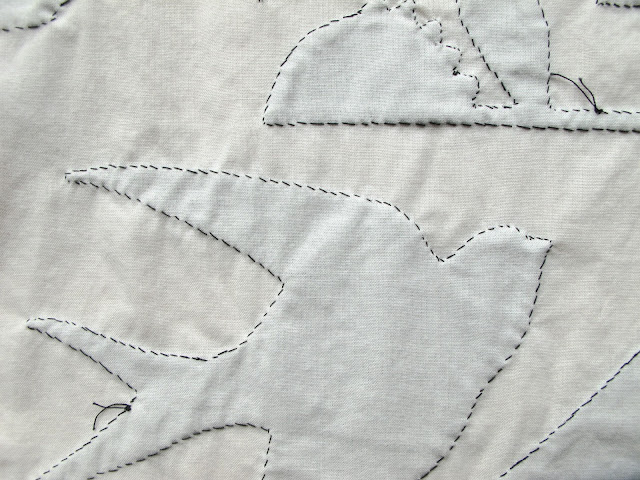
I used Warm & Natural for the batting and machine quilted around all of the objects just shy of 1/4" away. I quilted and bound the blanket in one day. It was another very focused day.

Quilts may no longer be allowed in the crib but they sure are handy on the floor. They are an ideal soft and washable place for babies to spend their day staring at the ceiling or getting cooed over by loved ones. The purpose of a quilt as a play mat was where the design of this quilt started. It was also inspired by my infatuation with two-colour, folk art, civil war era quilt designs.


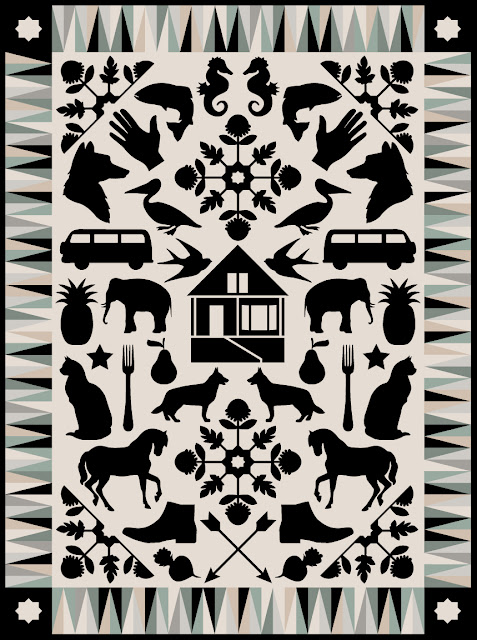
Designing the quilt was a highlight of the process. The objects I decided to include were inspired by the parents-to-be as well as pulling from traditional folkloric quilt objects. The personal items included are their beautiful character home, dog and their VW van. Some of the traditional quilt items are the fork, swallow, hand, pineapple, elephant and star.

Applique quilt

The image above was the initial "final" design. I originally had a colourful border but decided to nix it because I felt the objects really wanted to speak for themselves. Look at all of those objects that got cut, a Chelsea boot, pelican (I'm currently enamoured with these birds), horse, seahorse, cat and a turnip. All out of there because I realised the quilt wasn't quite to the scale I wanted. I never would have finished this quilt if I hadn't made those changes. Whew!

Applique quilt

8 years ago I started my 9-5 working life and I also began a running list of "Things I will do when I retire". Does anybody else have this?

The "Things I Will Do When I Retire" list in order of addition:

1. Learn to tap dance

2. Become a crazy quilt lady Check!

3. Learn to play the piano

Although I am not sure if I will tackle the other items during my hiatus, I am very thankful I was able to indulge my crazy quilting lady.

xoxo Melissa


Linking up with WIP Wednesday

WIP Wednesday at Freshly Pieced

May 16, 2013

JOCONDE IMPRIME STRAWBERRY MOUSSE CAKE

7 comments:
Joconde Imprime Cake

My obsession with french pastry techniques continues with this lovely joconde imprime cake.

Oh boy, did I learn a lot preparing this cake. Mousse. Zut. Shrinking sponge. Zut alors.

I loved the idea of taking some creative liberties with traditional french pastry techniques. I ended up using a fusion of French and North American recipes. Fusion cake? Bleh. Worst term ever. Or is it?.... Extreme fusion cake. Edgy extreme fusion cake. Cool edgy extreme fusion cake. Fo' shizzle my nizzle cool edgy extreme fusion cake! Oh dear.

Joconde Imprime Cake

Joconde imprime cakes are usually filled with layers of mousse, sponge, gelee, meringue and all sorts of other lovely french textural concoctions. I filled mine with layers of white cake, a strawberry curd and a white chocolate strawberry mousse. I used a north american-style white cake instead of an egg-y French genoise sponge because of taste preference.

The outside ring of colourful sponge cake is a traditional french recipe, it is called joconde imprime. This can be translated as almond sponge cake print or Mona Lisa print. You see, the French are much more formal and call Mona Lisa by her married name, La Joconde.

Joconde Imprime

Joconde imprime is made with a thick egg white and flour paste that is stenciled, piped or striped onto a silcone mat-lined cookie sheet. The patterned paste is frozen and then a light almond sponge cake is poured over top. It is baked, flipped, et voila!

Joconde Imprime

The absolute funnest part of making this cake was designing the stencil. I can't take credit for this design, it is inspired by Louis Reith, a fantastic Dutch artist and graphic designer.


Louis Reith in cake. I think I may send him some pictures. He could very well be horrified by a colour-changed and reflected version of his art on a cake. Je suis desolee Louis. Je suis desolee.

Joconde Imprime Cake

What I learned...

Gelatin can be very finicky. I discovered this on my first failed strawberry mousse. I used a fancy recipe that used fancy gelatin leaves and a fancy Italian meringue base. The recipe was not for beginners and the instructions were condensed. Needless to say my sugar syrup for the Italian meringue was practically candy when I poured it into my egg whites and my gelatin leaves got boiled. These are two big fat no-no's that led to a curdled inedible mousse.

I am very happy with the final mousse recipe; it uses the much more readily available powdered gelatin, no egg whites and one of my fave flavour enhancers, white chocolate. Thanks again Martha!

Freeze your sponge. Or work quickly. I lined my cake ring with the joconde imprime and left it out at room temperature covered with a tea towel for perhaps 2 hours and boy did it shrink. It was snug as a bug at first but by the time I began assembling there were tiny spaces between the sponge seams and more disappointingly the sponge had pulled away from the ring so that the top layer of mousse created a ledge. A ledge! Gosh forbid.

I will now attempt a tutorial on how I made this cake. The steps and recipes are in order of suggested preparation. Good luck!

Joconde Imprime Strawberry Mousse Cake

Yield: One 8" X 4 3/4" cake

Notes* 
You will need a few specialty tools to make this cake, an 8" cake ring or a removable-bottom cake pan ring, acetate strips, a silicone baking mat (I use Silpat). The cake layers, strawberry curd and joconde imprime can be made up to 4 days ahead but I suggest you make the joconde imprime the same day you assemble the cake. The strawberry mousse must be made the day of assembly.

1. Make Your Stencil

Stencil

What you will need:

Instructions:

1.  Using a glue stick, glue the stencil template to your stencil material. (I used a plastic file folder as my stencil material as it was the correct thickness, flexible, durable, washable, cuttable and in my house.)

2. Cut out the white areas and outline of the stencil design using your X-acto knife and self healing mat. Use your ruler for all straight line cuts. You will need to cut out the circles freehand; don't worry it will get easier as you go along. If you make a mistake and cut through part of the stencil just tape it back in place with clear tape and trim off the excess with your X-acto.

3. Remove the stencil template from your completed stencil. Gently wash the glue residue off of your stencil.


2. Make Your Fresh Strawberry Curd
Recipe adapted from: Scientifically Sweet

Ingredients:
  • 2 cups (340 g) sliced fresh strawberries
  • 2 large (50 g) egg yolks
  • 1/2 cup (100 g) granulated sugar
  • pinch of salt
  • 1 tablespoon (8 g) cornstarch
  • 3 tablespoons (45 ml) fresh lemon juice
  • 2 tablespoons (28 g) unsalted butter, softened and cut in cubes

Instructions:

1. Place strawberries in a medium size saucepan and simmer covered over medium-low heat, until liquefied, about 10 minutes.

2. Place a medium bowl with a fine mesh wire sieve near the stove. While the strawberries cook whisk together the egg yolks, sugar, salt, cornstarch and lemon juice in a medium bowl until smooth.

3. Temper the egg yolk mixture. Gradually pour the hot strawberry liquid into the egg yolk mixture while whisking constantly. Return the mixture to the saucepan and cook over medium-low heat for 5 minutes, stirring constantly with a spatula. Increase to medium heat and bring to a boil, boil mixture for 1 minute.

3. Strain the mixture through a wire sieve into a medium bowl. Using the spatula stir the mixture to help it flow through the sieve and gently push the curd through the strainer.

4. Gradually whisk in the butter, allowing each addition to incorporate before adding more.

5. Press a piece of plastic wrap directly onto the curd and pierce a few holes to let steam escape. Let cool at room temperature, transfer to a covered container and refrigerate for up to a week.


3. Make Your Cake Layers

1. Prepare a full recipe of this Cake-box Cake recipe and pour it into a 13" x 18" x 1" half sheet jelly roll pan. Using an offset spatula spread the batter to the edges of the pan and smooth the top as much as possible. Bake at 350° F (180° C) for 12-16 minutes until the top springs back when lightly touched.

2. Using an 8" cake ring, like a cookie cutter, cut out 2 rounds of cake. Left over cake can be used for immediate or later snacking.

3. Double wrap the cake rounds tightly with plastic wrap and place in freezer. May be kept frozen for up to 4 days.


4. Make Your Joconde Imprime
Recipe adapted from: Accro

*Note
I would have preferred a whiter joconde as a 'canvas' for the coloured stencil. I have made notes in the recipe for this revision.

Ingredients for the Joconde Decor Paste:
  • 3 tablespoons + 1 teaspoon (50 g) unsalted butter
  • 1/3 cup + 1 tablespoon (50 g) icing sugar (confectioners, powdered)
  • 1 (50 g) large egg white, room temperature
  • 1/2 cup (55 g) cake flour
  • 1 1/2 teaspoons (4 g) poppy seeds
  • Pink, Teal, Yellow, Black & Ivory gel food colouring

Ingredients for Joconde Sponge:
  • 85 g ground almonds
  • 75 g icing sugar (confectioners, powdered)
  • 25 g cake flour
  • 3 (150 g) large eggs, room temperature (Use 1 egg for whiter sponge)
  • 3 (90 g) large egg whites, room temperature (Use 7 egg whites for whiter sponge)
  • 2 1/2 teaspoons (10 g) granulated sugar
  • 2 tablespoons (30 g) unsalted butter, melted (Use 3 tablespoons for whiter sponge)

Instructions for the Joconde Decor Paste:

1. Using your paddle attachment cream the butter and icing sugar at medium-high speed until pale, light and fluffy, about 3 minutes.

2. Gradually add the egg whites and beat on medium-high for 3 minutes.

3. Remove the bowl from the mixer, sift the flour into mixture and fold until batter is smooth and well combined.

4. Separate batter in to 5 bowls for colouring; sorry I do not have an amount of paste for each colour. You will need a very small amount of pink, about 1 tablespoon. Make the poppy seed paste by mixing poppy seeds into the plain paste. To achieve softer, vintage colours mix tiny amounts of ivory food colouring in with the yellow, pink and teal.


5. Place your silicone baking mat on the back of a half sheet jelly roll pan. Place your stencil near the top left corner of the mat and fill your stencil following your handy colour guide. You are less likely to smudge your design if you fill the colours left to right. I used a tiny 3" metal spatula that came with my gumpaste tool kit to apply and smooth the paste; the back of a small shallow spoon may also work. Use a damp paper towel to clean your spatula between colours. Paste should be about 1/16" thick. Complete two rows of two repeats on your silicone mat.

6. Move your stenciled mat from the back of the pan to the inside of the pan. Freeze for 15 minutes to 2 hours.

Instructions for the Joconde Sponge:

1. Preheat oven to 450° F (230° C) and center rack.

2. Whisk egg whites in a stand mixer until frothy . Gradually add the granulated sugar and whip until you reach firm, glossy peaks. Reserve in a separate bowl.

3. Sift ground almonds, icing sugar and cake flour into the bowl of your stand mixer, no need to clean the bowl.

4. Using a paddle attachment gradually add the eggs into the dry mixture at medium speed. Mix well after each addition. Mix until smooth and light on medium-high speed about 2 minutes.

5. Fold in one-third of egg whites into almond mixture to the lighten the batter. Fold in remaining egg whites until no white streaks can be seen. Do not overmix.

6. Fold in melted butter.

7. Remove joconde decor paste from the freezer. Promptly pour joconde sponge batter over the decor paste. Using an offset spatula spread the batter to the edges of the pan and smooth the top as much as possible.

8. Bake for 4-6 minutes until the top springs back when lightly pressed. Do not let sponge brown, it should colour just slightly.

9. Cool for 30 minutes and flip onto parchment paper. Remove silicone mat. Cake should be right side up and pattern showing. Admire your work!

10. Cover with plastic wrap and keep at room temperature up to 2 days or make up to 4 days ahead and freeze tightly wrapped in plastic wrap. To defrost place in the refrigerator overnight and then bring up to room temperature before cake assembly.


5. Make Your Strawberry Mousse

Recipe adapted from: Martha Stewart


Ingredients:
  • 1 lb (454 g) fresh strawberries, stemmed and halved
  • 2 tablespoon (30 ml) fresh lemon juice
  • 16 oz white couverture chocolate, chopped
  • 5 teaspoons (14 g / 2 packets) powdered gelatin
  • 4 cups (1 L) whipping cream
  • 4 tablespoons (30 g) icing sugar (confectioners, powdered)
  • 2 tablespoons ( 15 g) strawberry jello powder (optional, for flavour)

Instructions:

1. Puree the strawberries in a food processor until smooth. Pass through a fine sieve into a bowl. You should have about 1 1/2 cups of puree. Stir in lemon juice and optional jello powder and set aside.

2. Melt chocolate in a medium heat proof bowl set over a saucepan of simmering water, stirring until smooth; set aside.

3. Put 1/2 cup of cool water into a small bowl. Sprinkle gelatin over top and stir gently; let stand until softened, about 5 minutes. Stir 1/2 cup cream and confectioner's sugar in a small saucepan; bring to a simmer over medium heat. Remove pan from heat and add gelatin. Stir until gelatin is dissolved.

4. Pour gelatin mixture into the bowl of melted chocolate, and stir until smooth. Stir strawberry puree into chocolate mixture.

5. Put remaining 3 1/2 cups of whipping cream into bowl of stand mixer fitted with the whisk attachment. Beat on medium-high speed until medium peaks form. Stir one-third of the whip cream into the chocolate mixture. Gently fold in the remaining whip cream until no white streaks remain.

6. Use immediately.


6. Assemble Your Cake

1. Place your cake ring on a parchment lined cookie sheet. Line your cake ring with acetate strips to a height of 4 1/2" to 5". (My acetate strips were 2 3/8" tall so I stacked them 2 rings high.)

2. Trim your joconde imprime to two, 4 1/4" wide strips, centering the design. Line your cake ring with sponge, matching the design across first seam. Trim the length of your joconde imprime to fit VERY tightly within the ring. You will need to adjust and measure this yourself. The design across your second seam will not match up; sorry, I'm not that much of a perfectionist yet.

Joconde Imprime

3. Using this 7 1/2" circle template trim one layer of your frozen Cake-box cake. Place it inside your joconde imprime lined cake ring. It will be an extremely snug fit. Carefully push the cake firmly to the bottom of the cake ring. I then brushed the cake with a vanilla sugar syrup but this is optional.

4. Spread half of the strawberry curd on top of the cake layer and smooth. Then pour one-third of the strawberry mousse, about a 1" layer, on top of the curd. Place the cake in the freezer for 1 hour. Ensure the cake is resting on an even surface.

5. Trim your second layer of frozen Cake-box cake with the circle template. Place it in the cake ring on top of the frozen mousse layer. Push the cake down firmly until it is evenly resting on the mousse. Brush with optional vanilla sugar syrup. Spread the remaining strawberry curd on to the cake. Pour the remaining mousse to the top of the acetate strips and carefully scrape the excess mousse off the top with a large ruler or metal spatula knife. Place the cake in the freezer overnight. Cake will keep in the freezer up to 4 days.

6. Thaw the cake in the refrigerator at least 6 hours before eating. Cake will keep in the refrigerator up to 3 days.


Whew! I think writing this post took as long as making the cake!

xoxo Melissa

May 10, 2013

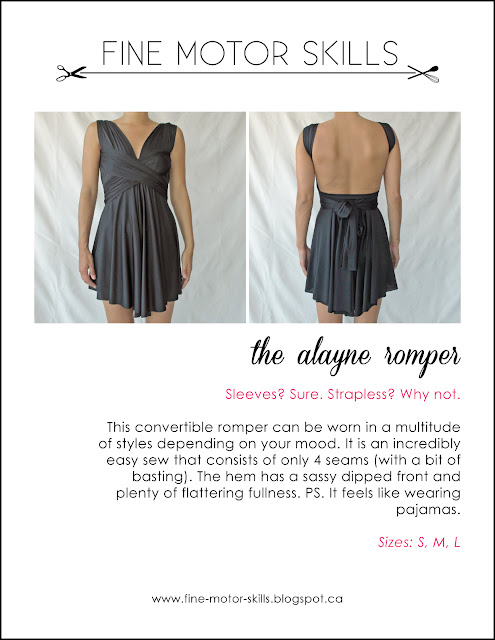
THE ALAYNE CONVERTIBLE ROMPER WITH PATTERN

10 comments:
Convertible Romper Dress Pattern

The simplicity of my patterns has been taken to a new level. This pattern contains 4 seams. What? Yes.

Convertible Romper Dress Pattern

This romper (yes, it's shorts) is inspired by the 'convertible dress'. If you haven't heard of it give it a google. It consists of a skirt and two very long straps that you use to wrap around your torso in an amazing amount of variations.

Convertible Romper Dress Pattern

Besides updating the convertible dress into shorts I also added a She-ra hem to help make it a little less bridesmaid-y. A She-ra hem is what I call a hemline that dips in the front and is higher at the sides. I've come to realize She-ra does not actually wear this type of hemline but it continues to be my descriptor.

Convertible Romper Dress Pattern

You may be wondering how supportive this type of garment is, well, not at all, in fact it likes to shift around a lot. So the styling above is my favourite way to wear the romper. Everything stays in its place.

Convertible Romper Dress Pattern

This sleeved variation was sweet but the chest is only one thin layer of fabric. Yee. This might be an over-swimsuit, going to the beach kind of wear.

Convertible Romper Dress Pattern

You see this strapless variation in all of the tutorials but it is the least comfortable. You don't feel very... safe. This is not a dancing with your hands in the air or running to the bus way to wear this style.

Convertible Romper Dress Pattern

It can also be worn in this adorable waisted variation, another favourite. The skirt is longer but with that much skin on top I think we're okay.

Convertible Romper Dress Pattern

This burgundy version was my first attempt and I ended up increasing the rise and adjusting the fall of the hem. I usually need to make two or even three versions of a pattern. I almost always run into something on my first sew-up.

There are many other ways to wear this convertible style and they are covered thoroughly with videos and pictures by other websites. Including a ton of halter variations that make my shoulders look massive so I've left those out.

A note:

> when you are wrapping yourself up, try and keep the back waist at an even level with the front waist. Don't let it drop down at the back. This will ensure your hem falls correctly.

Please download your Alayne Pattern here!


Convertible Romper Dress Pattern


Or visit my BurdaStyle profile here, where I am uploading patterns.

xoxo Melissa
Related Posts Plugin for WordPress, Blogger...